
Eight of ten sensors are in the ground
The second round of trial installations brings five more soil moisture sensors to deliberately difficult sites, and the assignment between sensor and tree sees its first use in the field.

Cedrik Hoffmann
Lead Developer & Project Lead
3 minutes read
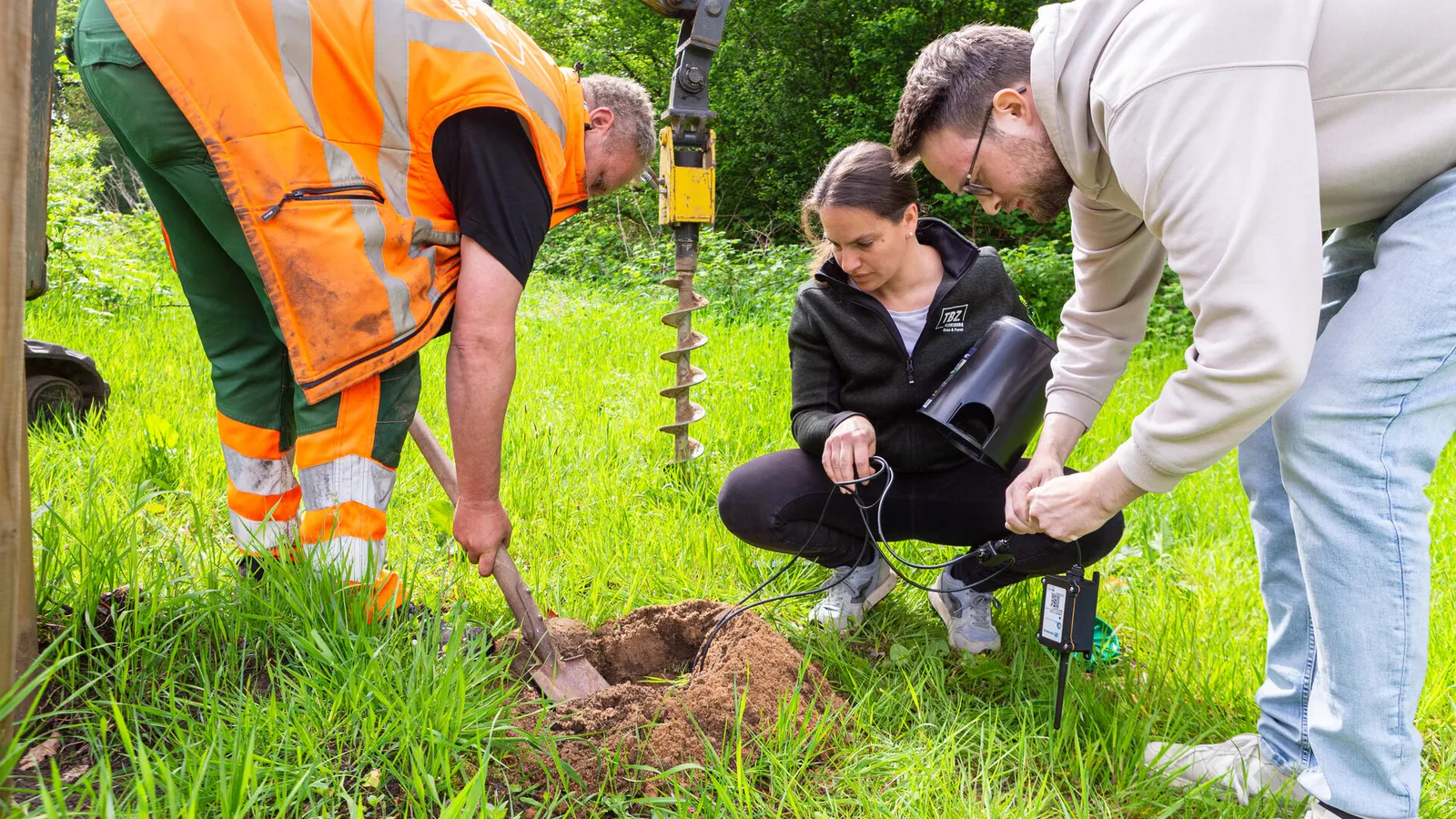
The first trial installation in May showed that the concept holds up. The second round on 11 June 2026 was meant to show whether it also does so where conditions are harder. For the next five sensors we deliberately picked extreme sites, together with the Technisches Betriebszentrum Flensburg (TBZ), the city’s technical operations center. A sixth site was on the plan as well, but construction work got in the way there. By the end of the day, eight of the ten planned sensors were in the ground nonetheless.
Lessons from the first round
The packing list has evolved since the first outing. The flashlight we had missed back then came along this time, joined by a wider drill head and a measuring device that detects buried cables before the auger does. What we needed most was patience. At some sites, stones and building rubble sat in the ground, and one drill head did not survive the day, though that looked more like old age than overly hard use. This is exactly what the trial installations are for; every trip out sharpens the routine for the next one.
The app’s first field test
At the first installation, assigning sensors to trees was still an item on the to-do list. Since version 0.2.0 the workflow has been part of the application, and on this day it had to prove itself outdoors for the first time. It is built deliberately for use on site: right at the freshly filled hole, the sensor’s QR code is scanned, the application uses the device’s GPS position to determine the nearest tree and links the two. We tested this with an iPad and a smartphone.
Completely buried
The installation method changed. The transmitter unit now sits entirely below ground, covered by a thin layer of soil. Nothing is visible above ground anymore, the sites stay unobtrusive, and maintenance work such as mowing is not affected. The open question was whether the LoRaWAN signal makes it through the extra soil. It does, the first data is coming in. Two of the installed sites, however, have not reported yet. At one of them a measurement taken beforehand had already shown weak coverage, so that fits the picture; we are following up on both.
From reading to interpretation
With every site the pool of data grows, and with it the real task moves closer. Readings have to become reliable statements about water demand. The same moisture value means something different depending on the soil, so the evaluation has to take the soil type into account. Studies on this exist for us to build on, and a first version of this evaluation will land in the application soon. So that the numbers do not stay theory, we then want to go back into the field together with the TBZ: dig a second hole next to a sensor, let the TBZ judge the soil by experience, and compare that with what our evaluation reads from the sensor data.
The last installation day
Next week the last sensors go into the ground. After that, all ten test sites are equipped, and the work shifts from digging to the data.