
Green Ecolution on the Schleswig-Holstein Magazin
Public broadcaster NDR reported on the urban trees that no longer survive the dry summers and showed Green Ecolution as one of the answers. The television piece aired on 29 August 2026, and an article went up on ndr.de the same day.

Cedrik Hoffmann
Lead Developer & Project Lead
3 minutes read
On 29 August 2026 at 19:30 the Schleswig-Holstein Magazin, the regional evening news programme of public broadcaster NDR, aired a piece about urban trees that no longer survive the dry summers. “Extreme Sommer: Stadtbäume in Not” runs a little over two minutes and much of it was filmed in Flensburg. An article by Aaron Schlichting went up on ndr.de the same day, and the Schleswig-Holstein news on NDR 1 Welle Nord radio picked the topic up as well.
Thousands of trees are already gone
The piece does not start with us, it starts with the problem. Deutsche Umwelthilfe, the German environmental action group, counts thousands of trees lost in Schleswig-Holstein’s cities over the past few years, with Lübeck and Neumünster hit hardest. Annette Eschenbach, professor of soil protection at the University of Hamburg, explains in the article why an urban tree has a hard time even without climate change. Sealed surfaces, utility lines underground, too little room for roots, too little water. A mature tree needs 200 to 500 litres a day to cool its surroundings noticeably. Nowhere near that much rain fell this year.
That is where demand-based irrigation becomes interesting. It does not stop climate change. It makes sure the water a city can actually deliver reaches the trees that need it right now.
What NDR showed from Flensburg
At the Technisches Betriebszentrum Flensburg (TBZ), the city’s technical operations centre, watering runs take a long time, and the rest of the centre’s work waits while they do. The piece shows a sensor disappearing 80 centimetres into the ground and where its readings end up: on a map at TBZ headquarters. A tree glowing red there means the soil is too dry. From those red dots the application plans the route for the next watering run.
So far there are ten test locations in Flensburg soil. Around 150 more sensors are due to go in before long. If the test phase goes well, the approach could work for other cities in Schleswig-Holstein too.
In the interview I said what the project means to me: living in Flensburg as a student and then building something together with the city that the city genuinely needs is not an everyday thing.
The shoot
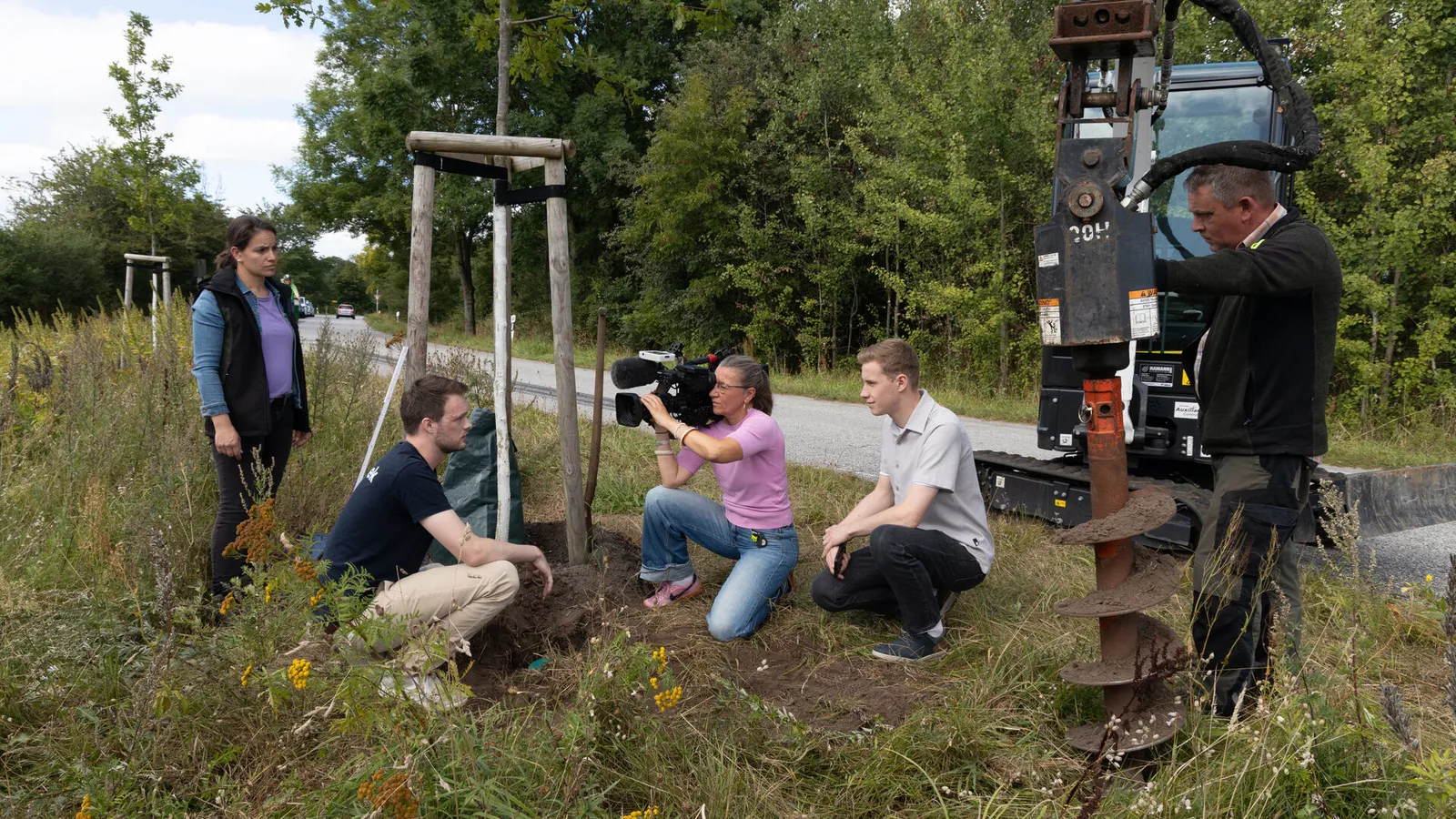
Filming took place on 24 August, one morning at the roadside. The earth auger came first. The excavator sets it down next to the tree and the hole is ready within minutes. Everything after that is done by hand and takes considerably longer. Positioning the sensor, laying the cable, backfilling.
Both sides went on camera. We explained how the system works and why we develop it as open source. The TBZ described what tree irrigation actually looks like day to day. Vehicles and time are scarce, demand varies from tree to tree, and so far the data to connect the two is missing.
Piece and article
The television piece stays in the media library until 29 August 2028, and NDR gave us permission to embed it here.
On ndr.de the piece sits at Extreme Sommer: Stadtbäume in Not. The article is at Trockenheit und Hitze in SH: Tausende Bäume in Städten sterben ab. Both are in German, as is the piece itself.